
Searching Bradley County Criminal Dockets
There is no official public name or case-number portal for all Bradley County trial cases. Begin with the Circuit & Criminal Court Clerk's official division list. Circuit Criminal Court and General Sessions Criminal Court have separate phone and filing contacts. A filing email is not necessarily a general records mailbox, so ask the division how it accepts a request for inspection, a docket sheet, or a copy.
Bring the full case number when known. If it is not known, give the party name, approximate filing year, court or division, charge type, and any known setting date. Ask for an existing docket or index, not a new countywide report. A broad name can match more than one person, while a citation number from Cleveland Municipal Court will not necessarily identify a state criminal case.
- Identify General Sessions Criminal or Circuit Criminal from the notice, charge, or prior filing.
- Contact the correct clerk division with the case number, name, and approximate year.
- Ask whether staff can confirm a setting, status, docket entry, or inspection process.
- Read each charge, motion, setting, plea, and disposition as a separate event.
- Ask about redaction, copy fees, and certification before ordering a document.
Bradley Criminal Court on Blythe Avenue
Adult criminal courtrooms are associated with the Bradley County Judicial Complex at 2230 Blythe Avenue. The county page lists Circuit Criminal Court at 423-728-7057 and General Sessions Criminal Court at 423-728-7050. Official pages differ on the ZIP code, so confirm mailing and entrance details before travel or delivery. The split matters because a call to the wrong division can delay a setting check.
The court-managed Bradley court list is useful for identifying the building and court family. It does not provide a live name-search database. Treat it as a routing source, then confirm the specific docket through the clerk.
The courthouse map also keeps unrelated records apart. Adult criminal work is on Blythe Avenue, civil work is centered at the North Ocoee courthouse, and juvenile matters use Johnson Boulevard. Cleveland municipal matters use Church Street. Reading the court name on a notice before calling is often the fastest way to avoid the wrong counter.
Inside a Bradley County Criminal Docket
A Bradley County criminal docket is an event index, not a plain-language account of the case. Fields vary by court, but the record can identify the assigned number, division, charges or counts, filed motions, hearing settings, pleas, orders, and manner of disposition. Always read an entry with its date and the signed order behind it when the precise result matters.
| Case Number | The court-assigned identifier, shown here only as court-specific number because no Bradley format was verified. |
|---|---|
| Charge or Count | The filed allegation and count structure; one case may contain several counts. |
| Hearing Setting | An arraignment, motion, plea, trial, review, or other scheduled event. |
| Plea or Motion | A filed event whose meaning depends on the later order and disposition. |
| Disposition | The recorded result, such as dismissal, plea, diversion, trial outcome, or transfer. |
Bradley Criminal Disposition Terms
The AOC's 2025 Bradley report separates guilty pleas as charged, guilty pleas to lesser charges, dismissal or nolle prosequi, diversion, acquittal, conviction after trial, retired or unapprehended matters, and transfer or remand. Those labels are aggregate reporting categories. They do not replace the individual docket or signed judgment.
- Setting
- A scheduled event; it does not show that the issue was decided.
- Continuance
- A delay or reset, not a dismissal.
- Diversion
- A procedural disposition category that is not automatically an acquittal or conviction.
- Nolle prosequi
- A disposition label that should be read with the actual docket and order.
How a Bradley Criminal Case Moves
The sequence depends on the charge and court, but a criminal docket commonly begins with a filed charge or initiating record, then records an arraignment and pretrial activity. Motions, service, discovery events, continuances, and settings may follow. A plea or trial is not the last item in every matter because sentencing, probation issues, post-conviction filings, or an appeal may add later entries.
Docket flow: Filing › Arraignment › Pretrial › Plea or Trial › Disposition › Sentencing
Bradley Criminal Dockets by the Numbers
The official AOC fiscal 2025 report lists 1,760 Bradley criminal filings and 2,444 dispositions. Its filing categories include 502 probation violations, 309 drug matters, and 297 burglary or theft matters. These are reported counts, not unique defendants, a crime-rate measure, or a live case-search result.
A separate June 30, 2024 snapshot reported 2,200 pending counts or cases, most in the zero-to-three-year band. The date and reporting unit matter. Neither report answers what happened in one case; the individual Bradley County criminal docket does.
The 2025 disposition total includes 1,514 guilty pleas as charged, 592 dismissals or nolle prosequi entries, 73 guilty pleas to lesser charges, 55 diversion entries, nine convictions after trial, and two acquittals. These counts show why a generic “disposed” label needs context. A plea, dismissal, diversion, and trial result are legally distinct events, and only the docket and related order identify the result for a particular matter.
Courts That Hold Criminal Dockets
General Sessions Criminal Court is the limited-jurisdiction criminal route, while Circuit Criminal Court handles the felony trial function identified by Bradley's official court sources. Cleveland ordinance citations belong to Cleveland Municipal Court. A state DUI or other criminal traffic charge may instead be in General Sessions or Circuit Criminal, so the municipal citation portal cannot be treated as a county criminal search.
If the case is appealed, the Tennessee Court of Criminal Appeals history may appear in AOC Public Case History. That appellate layer is separate from the original trial docket. Juvenile delinquency and detention matters use the Juvenile Court office and carry stricter access expectations.
Circuit Criminal and General Sessions Criminal both appear on the county contact page, but they are not interchangeable labels. Ask staff which division holds the number before requesting copies. If the answer points to Cleveland Municipal Court, use the city-citation route. If it points to a state appeal, use C-Track. Federal criminal matters use the Eastern District of Tennessee and PACER instead of either state system.
The requested item also affects the route. A docket sheet gives the event trail, while an indictment, judgment, sentencing order, or recording is a separate record product. A person confirming the next setting should ask for the latest scheduled event and whether it has been continued. A person checking the outcome should ask for both the disposition entry and the signed order. That wording helps the division answer a narrow question without treating a hearing date, filed charge, and final result as the same thing.
Bradley Criminal Docket Practice Rules
The Bradley General Sessions Division I local rules cover sessions, scheduling, motions, continuances, confidential records, trials, orders, and remote participation. They also name Quest Case Management Software. A back-office system name does not establish a public portal, and an e-filing rule does not promise public document downloads.
The official local-rules source explains division practice. Confirm the live setting and filing method with the clerk because a local rule, hearing notice, and current docket each serve a different purpose.
The court-managed General Sessions page contains an illustrative docket-days table that is explicitly fictional. It must not be used to infer a recurring live schedule. The actual case notice, clerk confirmation, and current setting control. Local rules mention remote participation, yet that does not mean a given hearing is remote. Obtain any approved link or passcode from the court and never reuse one taken from a private notice.
Bradley's division contacts also distinguish filing from public access. The county page publishes filing email addresses, but research did not establish that each address accepts a general docket request. Before attaching a pleading or asking for a record, confirm which inbox applies, whether the matter is Circuit Criminal or General Sessions Criminal, and whether the office requires another delivery method. This is especially important where official county and AOC contact blocks differ.
Bradley Criminal Court Official Directory
The AOC judicial directory entry for Judge Sandra Donaghy shows how Tennessee identifies the Tenth Judicial District and Bradley court service.
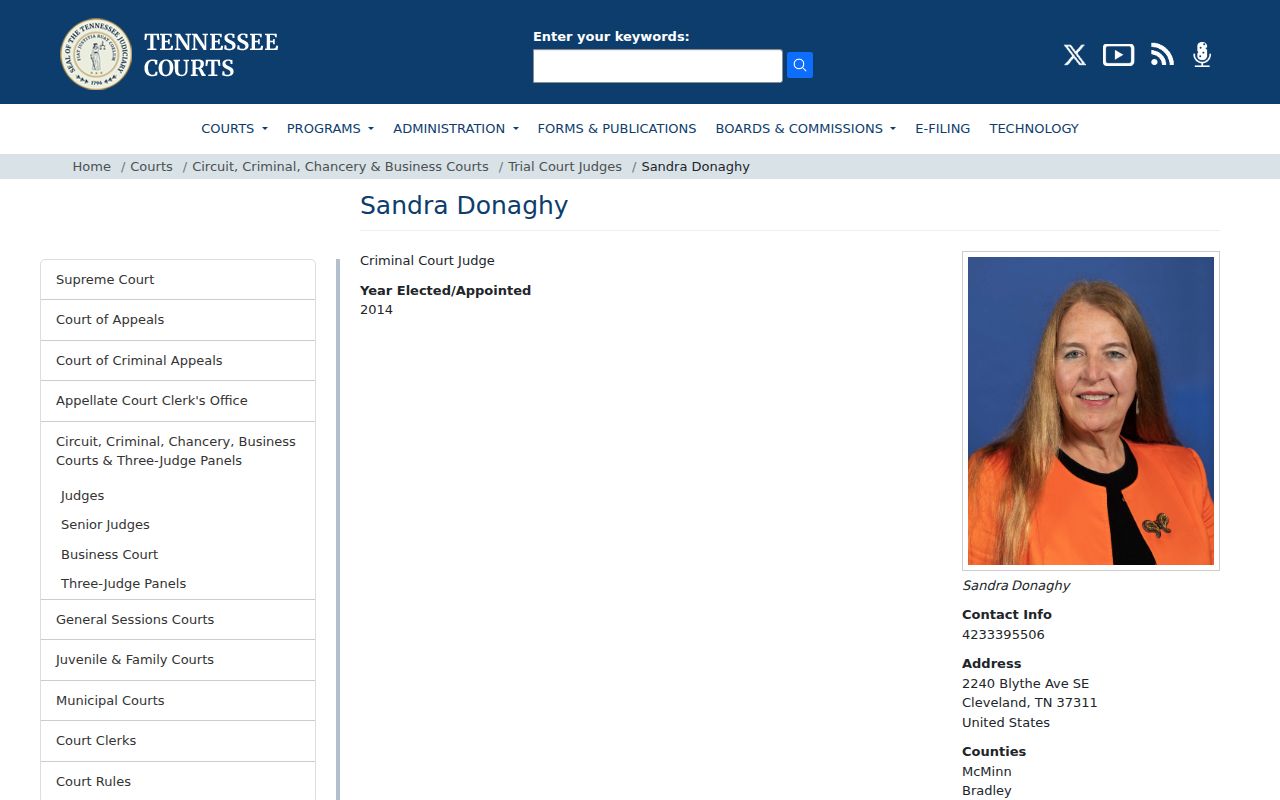
The directory helps verify court structure and public office information, but the Bradley clerk remains the source for a specific docket, filing, or setting.
For a useful request, separate the docket sheet from an indictment, disposition order, transcript, or official recording. State the court, number, party, approximate year, and exact item. Then ask whether the record is open, whether a plain or certified copy is available, what fee and delivery method apply, and whether any part will be redacted. Bradley's public pages do not publish a complete criminal copy-fee table or turnaround standard. Rule 26 governs official electronic recordings, but an audio copy is not a transcript. Confirm the court's current recording or transcript process before ordering either product.
Sealed Dockets and Public Access
Tennessee Supreme Court Rule 34 supports inspection of public court records subject to statutes, court rules, sealing orders, protective orders, and reasonable access procedures. A public docket entry does not guarantee that every linked filing is open. Victim information, protected addresses, medical or financial details, juvenile material, and sealed documents may be withheld or redacted.
Key access rule:
Tennessee Supreme Court Rule 34 recognizes public inspection while preserving legal exceptions and reasonable court procedures.
Ask the criminal clerk whether an entry or document is open, sealed, confidential, or redacted, and request any non-exempt portion.